
Table of Contents
- Top Features at a Glance
- What Are Surgical Instruments?
- Types of Surgical Instruments — What You Need to Know
- Benefits of Using Quality Surgical Tools
- Use Cases — Where Are These Instruments Applied?
- Common Surgical Instrument Categories — Quick Reference
- Pros and Cons of Standard vs. Speciality Instruments
- Who Should Buy These Instruments?
- Customer and User Experience
- About Sangam Surgicals
- Conclusion
Your practical guide to understanding medical-surgical instruments — from basic types and real-world uses to finding the right surgical instrument manufacturers in India for your facility.
Nobody outside a hospital setting really thinks about this stuff. You go in for surgery, they put you under, and somehow everything works out. But if you've ever stood inside an OT — even briefly — you know how much depends on what's sitting on that tray.
Surgical instruments are, honestly, one of the most underappreciated parts of medicine. Not the surgeon's training. Not the anaesthesia. The actual, physical tools that cut, hold, clamp, and close. Get those wrong and everything else falls apart, no matter how skilled the team is.
This guide is for people making buying decisions, running hospital procurement, or just trying to understand what separates decent surgical equipment from the kind that creates problems in the middle of a procedure.
Top Features at a Glance
Not all Medical surgical instruments are made equal. Here's what actually matters when you're comparing options — not just the spec sheet:
- Surgical-grade stainless steel that doesn't pit or rust after a dozen autoclave runs
- Weight that feels right in the hand — not too heavy, not flimsy
- Hinged joints with zero wobble — this is a bigger deal than it sounds
- No sharp ridges on grip areas where hands rest during long procedures
- Verified ISO 13485 or CE certification — ask for documents, not just claims
That last one? Plenty of suppliers skip it. And it only becomes a problem when something goes wrong and the hospital needs to show compliance.
What Are Surgical Instruments?
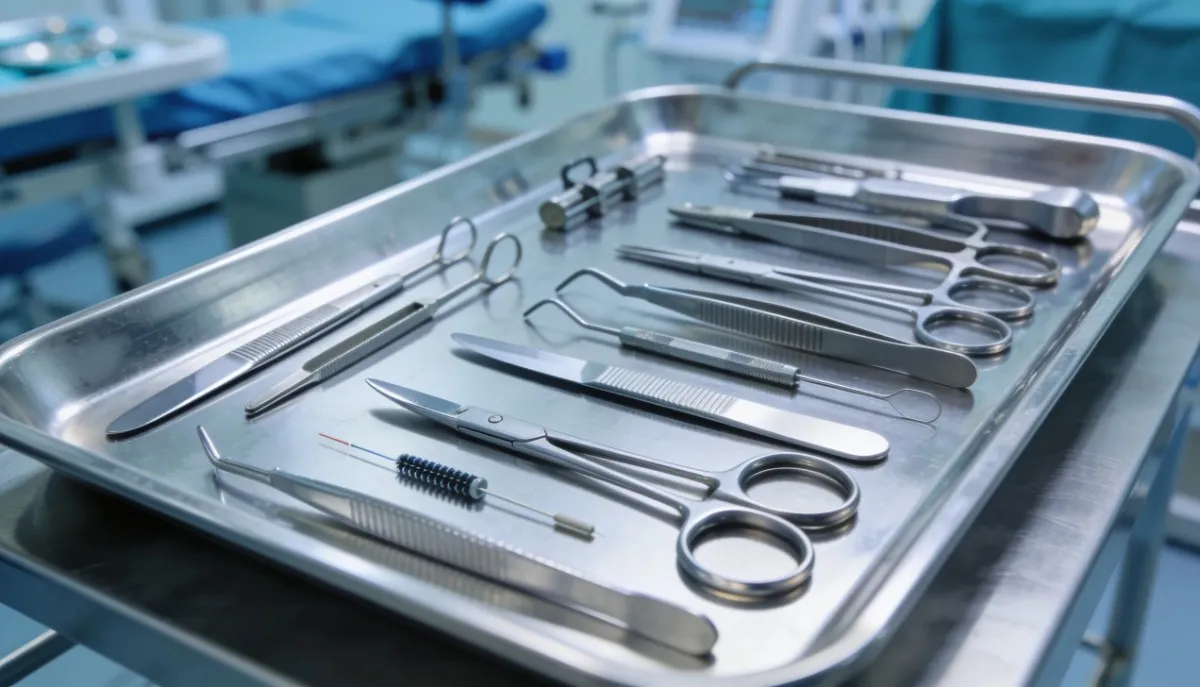
A surgical instrument is the tool on which the surgeon depends as soon as he has entered the operating theatre – scalpels to cut, forceps to grasp, retractors to move tissue away and needle holders to stitch together an opening. They all have a purpose, and only one purpose, in and of themselves. To look at them, you would think that they were of negligible difference, but in the midst of a 3-hour operation, the variation between a well-made instrument and a poorly made one does not seem like such a tiny thing. It is safe for the patient.
Types of Surgical Instruments — What You Need to Know
The types of surgical instruments used in an OT cover five broad functions. Every category is specific — you can't swap between them.
1. Cutting and Dissecting Tools
Scalpels, surgical scissors, bone saws. First contact with tissue. The sharpness here isn't just about cutting clean — it's about how much surrounding tissue gets disturbed in the process.
2. Grasping and Holding Tools
Forceps, clamps, needle holders, towel clips. Without these, a surgeon would need three hands. Good ones hold without slipping; bad ones become a problem fast.
3. Retractors and Exposure Tools
These pull tissue back so the surgeon can see. Sounds simple. In practice, a retractor that shifts unexpectedly mid-procedure is genuinely dangerous.
4. Suturing and Stapling Tools
Needle drivers, suture scissors, surgical tools for closing. Wound closure is where a lot of post-operative infections start — so the quality of these instruments has a direct downstream effect on patient recovery.
5. Diagnostic and Examination Tools
Speculums, dilators, probes. Not every procedure involves a large incision. These create controlled access without needing to cut much at all.
Benefits of Using Quality Surgical Tools
The honest version of this section: cheap instruments cost more in the long run. That's not a marketing line — it's what procurement teams figure out after a few replacement cycles.
- Fewer complications mid-procedure — sharper, more reliable tools reduce accidental tissue damage.
- Less surgeon fatigue — balanced weight matters in a 3-hour operation.
- Longer service life — proper alloy grade handles repeated sterilisation without degrading.
- Better sterilisation tracking — consistent finishing and clear markings help nursing staff.
- Lower total cost — fewer breakages and replacements over 2–3 years of regular use.
Use Cases — Where Are These Instruments Applied?
When people think of medical surgical instruments, they usually picture general surgery. But the range is much wider.
- General surgery — hernia, appendix, gallbladder, wound debridement
- Gynaecology — hysteroscopy, laparoscopy, C-section instrument packs
- Urology — TURP procedures, cystoscopy, kidney stone removal
- Orthopedic instruments — bone plating, joint replacements, fracture fixation
- ENT — tonsillectomies, sinus surgery, myringotomy
- Dental and oral — implants, extractions, oral biopsies
- Cardiovascular — bypass grafts, valve repair, arterial clamping
- Laparoscopy — minimally invasive abdominal and pelvic procedures
Common Surgical Instrument Categories — Quick Reference
| Category | Common Examples | Primary Function | Typical Speciality |
|---|---|---|---|
| Cutting Tools | Scalpels, Scissors | Incision & Dissection | General Surgery |
| Grasping Tools | Forceps, Clamps | Holding & Gripping | All Specialities |
| Retractors | Handheld, Self-Retaining | Exposure of Field | Abdominal, Ortho, ENT |
| Suturing Tools | Needle Holders, Staplers | Wound Closure | General & Cardiovascular |
| Orthopedic Tools | Bone Plates, Reamers | Bone & Joint Surgery | Orthopaedics |
| Diagnostic Tools | Speculums, Probes | Examination | Gynaecology, ENT |
Pros and Cons of Standard vs. Speciality Instruments
Pros of Investing in Quality Instruments
- Last year — properly cared-for instruments don't need annual replacement
- Feel matters — surgeons work better with tools that give good tactile feedback
- Fewer theatre interruptions — reliable tools don't slip, misfire, or jam
- Easier compliance — certified instruments simplify hospital accreditation audits
Cons to Watch Out For
- Higher upfront spend — quality instruments aren't cheap, that's the tradeoff
- Training required — some speciality sets need correct handling to avoid damage
- Servicing needed — advanced instruments occasionally need recalibration
Who Should Buy These Instruments?
Anyone searching surgical instruments online or evaluating Surgical instrument suppliers should have a clear sense of what they're buying for. The usual buyers include:
- Government and private hospitals upgrading or expanding OT capacity
- Clinics branching into laparoscopy, urology, or other specialities
- Medical colleges needing training sets and demonstration equipment
- Bulk procurement agents sourcing for export or multi-facility supply
- Private surgeons equipping personal or group practice spaces
Things to Consider Before Buying
Before you start comparing surgical instrument prices across five different catalogues, get these basics straight:
- Steel grade first — 316L or 410 stainless is what surgical use actually demands.
- Autoclave compatibility — some finishes degrade faster than others under repeated heat.
- Certification proof — ISO 13485 and CE documents should come with the order, not after you ask three times.
- Procedure match — a general surgery set won't serve an orthopaedic OT; get the right category.
- After-sales clarity — find out what the replacement and support process looks like before buying.
Customer and User Experience
Talk to scrub nurses about new instruments and they'll tell you the same thing every time. Weight and grip. That's what they notice in the first five minutes. Not the box it came in.
Hospitals sourcing stainless steel surgical instruments from Surgical instrument manufacturers in Delhi consistently say the same thing: follow-up support matters as much as the product itself. A supplier who picks up when something breaks — that's the real value.
About Sangam Surgicals
Sangam Surgicals was founded in 2014 by Mr. Rajkumar Singh with one clear purpose — put better instruments in the hands of surgeons. The company supplies and exports surgical instruments to hospitals and clinics across India and globally. The range covers laparoscopy, gynaecology, urology, arthroscopy, endoscopy, harmonic scalpels, and surgical staplers — all made from premium-grade stainless steel, built to international quality standards. With ISO-compliant processes and a team of 25+, Sangam Surgicals has spent over a decade doing one thing well: delivering instruments that perform when it matters most. Precision isn't a feature here. It's the baseline.
Conclusion
A procedure doesn't begin with the incision. It begins with the tray. If the surgical instruments on that tray are wrong — wrong quality, wrong grade, wrong certification — everything downstream carries that risk.
India has plenty of manufacturers in this space. Some are genuinely good. Others sell on price and rely on buyers not knowing the difference. The Surgical Instrument Manufacturers in India worth working with are the ones who treat certification as a given, not a selling point.
If you're re-evaluating your current supplier or sourcing for a new facility, the standard shouldn't be the cheapest option. It should be the one that works — consistently, safely, every time.
Visit Sangam Surgicals to explore their full catalogue of medical surgical instruments — or reach out directly at sangamsurgicals.in for bulk pricing, custom sets, or a detailed product enquiry.
FAQs Related to What Are Surgical Instruments and Why Are They Important?
They're used to cut, hold, retract, and close tissue during operations. Every tool has one specific job and doing that job consistently, without failing mid-procedure, is the entire point.
Ask for ISO 13485 certification documents upfront. Check if they supply to actual hospitals, not just distributors. Call references. A good supplier answers questions without deflecting or delaying unnecessarily.
Ask for ISO 13485 certification documents upfront. Check if they supply to actual hospitals, not just distributors. Call references. A good supplier answers questions without deflecting or delaying unnecessarily.
Ask for ISO 13485 certification documents upfront. Check if they supply to actual hospitals, not just distributors. Call references. A good supplier answers questions without deflecting or delaying unnecessarily.
Ask for ISO 13485 certification documents upfront. Check if they supply to actual hospitals, not just distributors. Call references. A good supplier answers questions without deflecting or delaying unnecessarily.
Depends on usage and care. Quality instruments last years with proper sterilisation and storage. Watch for jaw misalignment, surface rust, or grip looseness — those are your replacement signals.