
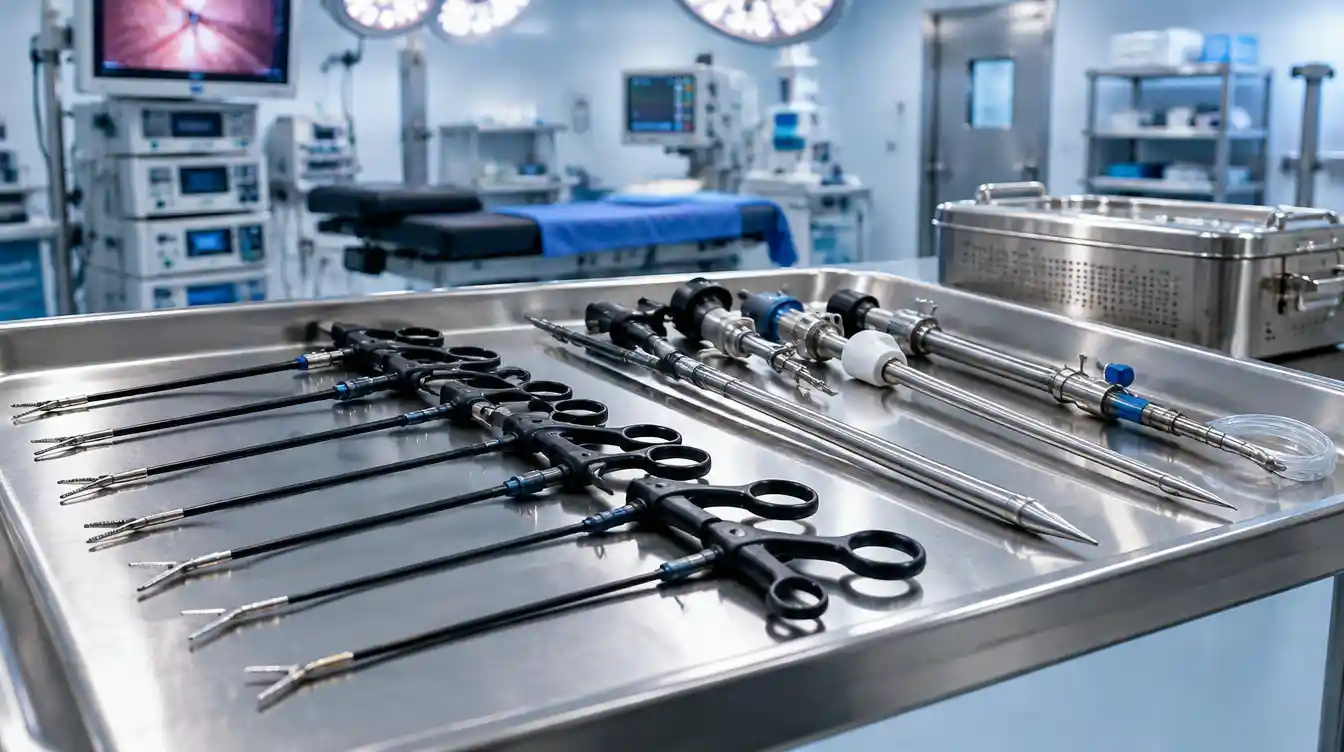
In the field of hospital surgery, hospitals spend a lot of money on a variety of surgical instruments and the laparoscopic instruments are among the most commonly used surgical equipment in minimally invasive surgery. The reusable laparoscopic instruments are one of the areas that procurement teams are considering in order to keep patient safety as their utmost priority while also managing the cost of the process.
The cost of an instrument is just as important as the instrument's value, along with its lifespan, reprocessing needs, surgical volume, and performance.
What Are Reusable Laparoscopic Instruments?
Reusable laparoscopic instruments are surgical instruments that are intended to be reused following appropriate cleaning, inspection and sterilisation. They are usually made of medical stainless steel and designed to be reprocessed multiple times without any loss of precision, strength, or corrosion resistance.
Reusable surgical instruments are not single use instruments, but rather are included in the hospital surgical inventory. They are to be cleaned, decontaminated, inspected for damage and sterile after each procedure, as per the manufacturer's instructions. It is important to ensure proper reprocessing as the instruments used in laparoscopy touch the internal tissues and need to be at a very high standard of cleanliness before they can be used again.
Common reusable laparoscopic instruments are graspers, dissectors, scissors, needle holders, trocars, cannulas and suction-irrigation devices. Not all the laparoscopic devices can be reused, however, some energy-based devices, staplers and special parts are designed for one time use or limited use.
Are Reusable Laparoscopic Instruments Cost-Effective?
Usually, yes. For procedures that are performed often and the instruments are properly maintained, cost-effective laparoscopic instruments can be reusable. The first bill is bigger than for disposables. The greater the number of additional cases, the more affordable the procedure becomes.
Imagine a re-usable grasper. The cost up front is high. After hundreds of procedures, the costs of each use are much less than the cost of a new dispositive.
Research agrees. A systematic review of disposable and reusable tools in minimally invasive surgery revealed that in general surgery, reusable instruments were always associated with decreased per-procedure costs, ranging from $16 to $388.
But it's not a certainty. A hospital should take all the following factors into account to track the instrument's life; cleaning, sterilisation, staff time, repairs, spares and retired instrument disposal. Viewing that big picture is when the laparoscopic instruments cost makes sense. Where reusables are safe and reliable throughout their service life they can be a cost-effective investment.
Key Factors That Affect Long-Term Cost Savings
What you save comes down to a few plain factors. When you plan hospital equipment procurement, think about what an instrument costs over its whole working life. The first invoice is only one piece of that.
Initial Purchase Cost and Instrument Lifespan
Laparoscopic instruments price is higher for reusables. You’re also paying for spare parts, storage, and often a few extra sets so the OT list doesn’t stall mid-morning.
Lifespan counts the most. A stainless-steel instrument with straight jaws, sound insulation, a smooth action and a firm lock after many cycles is money well spent. One that’s forever in for repair isn’t.
Steady performance matters too. In its hundredth case, it should grip as well and handle tissue as gently as it did in its first.
Sterilisation and Maintenance Expenses
Laparoscopic instruments maintenance is a fixed expenditure in the budget for reusable surgical instruments. Consider manual cleaning, ultrasonic cleaning (if necessary), disinfection, drying, inspection, packaging, sterilisation, cooling, storage and record-keeping.
Requires trained CSSD staff, proper equipment, water, detergents, wraps or containers, indicators, electricity and quality checks. Reprocessing medical devices requires a lot of steps to be repeated and each time done exactly the same way to ensure the next patient is protected.
For critical instruments that will not be harmed by heat, steam, pressure or moisture, steam is the preferred method by CDC. Check for corrosion, debris, damaged insulation, loose parts and misalignment after each cycle.
Make plans to repair and do routine maintenance too. The life of an instrument is extended with regular maintenance. Do not try to fix it, you might incur breakdowns, delays in surgery or early replacement.
Frequency of Surgical Procedures
When it comes to the Laparoscopic instruments for hospitals, it is the volume that plays a significant role in judging. Laparoscopic instruments that are used frequently every day at a hospital with many laparoscopic cases will be distributed among many operations, which lowers the hospital's purchase price.
State that a reusable instrument is much more expensive than a disposable instrument, but can be used safely for hundreds of cases. The cost per procedure can be a lot less. In a quiet facility, the same instrument could be unused for weeks or require expensive repair and maintenance and the saving decreases.
Reusable vs Disposable Laparoscopic Instruments: Cost Comparison
Neither option wins every time. It depends on the instrument, your workflow, case volume, infection-control rules and budget.
| Factor | Reusable laparoscopic instruments | Disposable laparoscopic surgery equipment |
|---|---|---|
| Initial cost | Usually higher | Usually lower per unit |
| Cost per procedure | Can be lower with high utilisation | Stays fairly constant |
| Reprocessing | Needs cleaning, sterilisation, inspection and documentation | Not required |
| Staff and equipment | Needs trained CSSD staff and sterilisation setup | Lightens the reprocessing workload |
| Replacement frequency | Lower if durable and maintained | Higher, since each is discarded after use |
| Waste generation | Generally lower over time | Higher because of repeated disposal |
| Best suited for | High-volume hospitals with strong reprocessing systems | Low-volume settings, emergency use or specific single-use devices |
Using re-usable tools also involves less repeat buying and reduced waste disposal costs. With disposables, you don't have to reprocess. There are so many hospitals that just use both – disposable/little use when needed by the clinical case and reusable stainless steel for standard laparoscopic instruments.
How Can Hospitals Choose Cost-Effective Laparoscopic Instruments?
The lowest quote isn’t always the lowest cost. What counts is how an instrument performs over time. When you compare laparoscopic instruments suppliers and Laparoscopic instruments manufacturers, a few questions are worth asking before you sign anything:
- Is the steel medical grade, or another material that copes well with repeated sterilisation?
- Will it survive your own validated cleaning and sterilisation routine?
- Do the size, jaw design, insulation, rotation and locking suit the procedure and your current setup?
- How long should it last, and can you get spares and repairs without a long wait?
- Does the supplier deliver on time, give technical advice and stay around after the sale?
- What’s the total cost once purchase, reprocessing, repairs, replacement and disposal are added up?
- Can they hand over material details, cleaning instructions and quality papers?
The right supplier won’t just sell you stock. They’ll help you work out what mix suits your procedures, case volume and reprocessing capacity.
Why Choose Sangam Surgicals for Laparoscopic Instruments?
Sangam Surgicals is among the reputed laparoscopic instruments manufacturers in India, who provide hospitals, surgical centres, clinics and distributors with laparoscopic instruments. The range includes laparoscopic graspers, scissors, dissectors and needle holders, trocars, cannulas, versus needles, clip applicators, suction-irrigation devices and other endoscopy equipment.
If hospitals are more inclined towards re-usables then there are stainless-steel instruments which are designed for precision and repeated sterilisation. There are reusable and disposable versions available, so hospitals have to select depending on their clinical needs, hygiene protocol and budget.
Service includes bulk supply, customisation and assistance in product selection. Contact us when you are looking for comparison of top laparoscopic instruments suppliers in India, and get to know our specifications, quotations, bulk pricing and advice that suit you, in your surgical and purchasing needs.
Conclusion
So, are reusable laparoscopic instruments worth it? For busy hospitals with good cleaning, inspection and sterilisation routines, usually yes. The upfront cost stings. Over the years, though, each procedure tends to cost less than it would with disposables.
Just don’t judge by the purchase price alone. Look at the full lifecycle cost. Durability, reprocessing expense, case volume, repair support and the supplier all count.
| Need durable laparoscopic instruments, bulk supply or help choosing the right ones? Sangam Surgicals can share product details and quotations based on your surgical needs. |
FAQs Related to Are reusable laparoscopic instruments cost-effective for hospitals?
There’s no fixed number. It depends on the manufacturer’s instructions, the design, how often the instrument is used, how it’s handled, how well it’s maintained and what inspection shows after each cycle.
Often, per procedure, if they’re used regularly and cared for well. When you compare reusable vs disposable laparoscopic instruments, count cleaning, sterilisation, staff time, repairs, replacement and disposal as well.
Check material quality, sterilisation compatibility, specifications, spare parts, supplier support, warranty and lifecycle cost. Ask the supplier for clear reprocessing instructions and documents too.
Not when they’re cleaned, inspected and sterilised properly under validated protocols. Trained staff, maintained equipment and regular quality checks keep reuse safe.
Standard handheld tools like graspers, dissectors, scissors, needle holders, trocars and suction-irrigation devices usually come in reusable versions. Energy devices, staplers and some specialised instruments may be single-use or limited-reuse.
Yes, if they do enough cases and have reliable sterilisation facilities. A small hospital can still save when its instruments are in regular use.