
When you ask a few lab owners about their initial purchase of equipment you will get the same story. The statement seemed reasonable and the machine functioned adequately. The first breakdown occurred at month 6 and nobody could be reached. This is a considerable burden to be given for one afternoon's choice.
This blog is for the purpose of making that decision. When you open your first centre or grow and expand an older one, your reports will be influenced by the laboratory equipment you make for years. We will discuss the top diagnostic laboratory equipment that is used by Indian centres and some points that will help you to decide before making the payment.
Why Quality Laboratory Equipments Matter in Diagnostic Centres
Imagine a pipette that is a few percent out, no one knows. Reports are coming out of the lab and there's nothing amiss, except for one report that doesn't add up until now. But that is not the case with good laboratory equipments and reliable medical laboratory instruments are generally a few simple practices:
- Calibration done on schedule and written down.
- Samples are handled properly, one at a time.
- Book your servicing without the fear of anything going wrong.
- Matches results at 6 pm and 9 am.
The money argument is no different. A second test is a waste of reagent, technician time and a patient's patience, and a consistent lab loses a lot of each.
Essential Laboratory Equipments Used in Diagnostic Centres
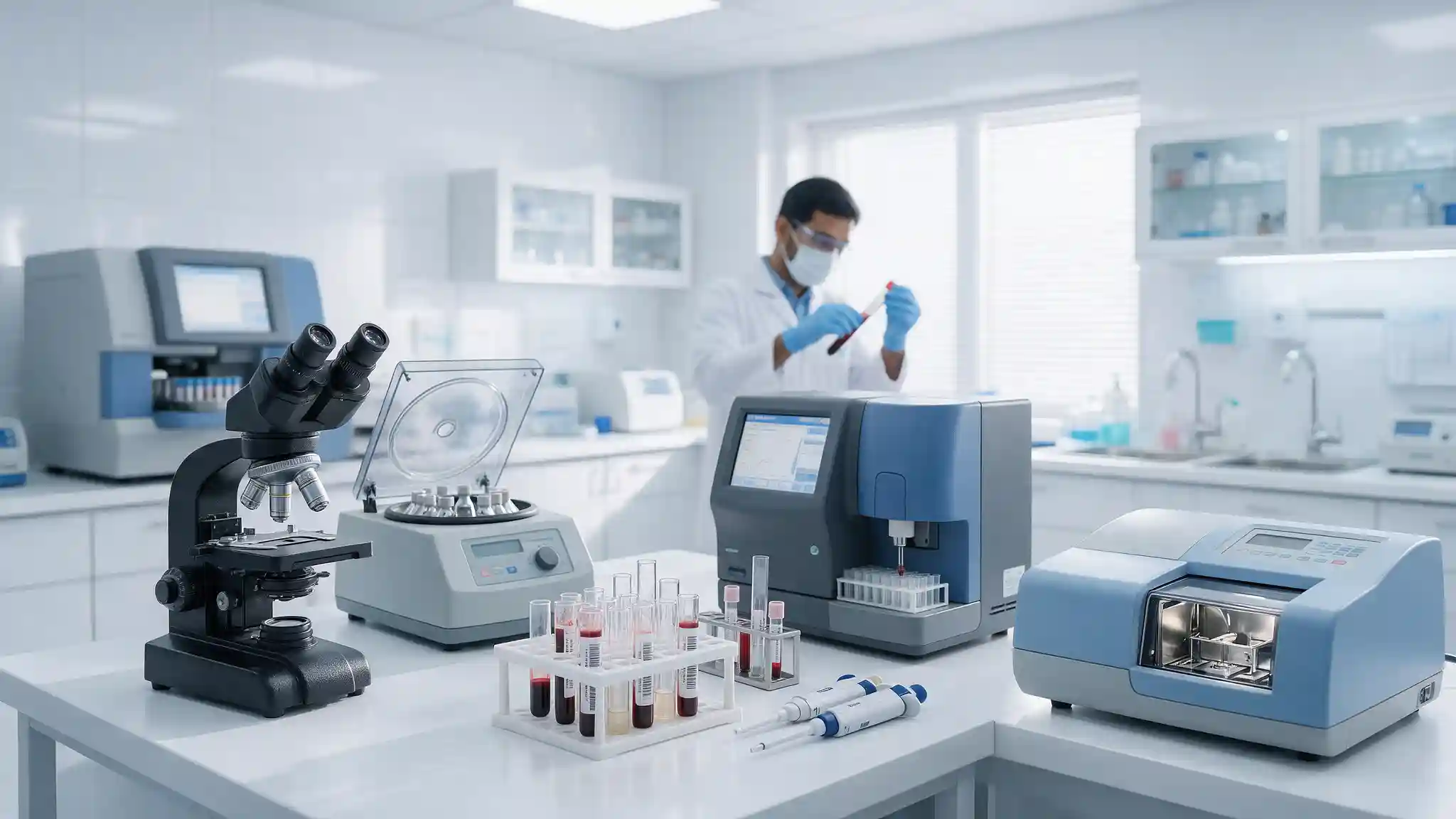
A shopping list is not determined by a catalogue, it is determined by the tests that you offer. A small collection centre can use 6 or 7 machines. A complete pathology laboratory (biochemistry, haematology and microbiology) requires a considerable amount more. Estimate samples per day first, and then develop your laboratory equipment list around the number of samples. The laboratory instruments below will be the largest number of instruments found in most labs.
Microscopes and Centrifuges
The laboratory microscope is nearly at the front of the pack since smears, sediment and stained slides still solve many cases. If slides are being read for hours, a good binocular optics is appreciated. Putting in a camera port is also useful if you want pictures for record, for a colleague to view a difficult case, etc.
The background action of a laboratory centrifuge. Blood is separated into layers, from which clear blood plasma or serum can be drawn off. When assessing models, verify the speed range, rotor size and lid locking system. Noise is important to consider too – the machine is within a few feet of your techs throughout the day in a small lab.
Biochemistry and Hematology Analyzers
The majority of what a biochemistry analyzer does is to measure blood sugar, cholesterol, liver enzymes and creatinine. With only a few dozen samples you can do a day, a semi-automated unit is fine. Manual efforts become a hassle as volumes increase and full automation becomes cost effective.
A complete blood count can be obtained in minutes with a hematology analyzer. Routine counts are covered in 3-part models. For a doctor with a lot of patients, a five-part model might be worth the extra money because these doctors can see the details on the white cells too.
Incubators, Autoclaves and Micropipettes
Laboratory Incubators are used in the lab to maintain cultures at constant temperatures. All you need to know is how evenly the heat is distributed throughout the chamber, but there is little information in the display number.
Autoclaves are required. The glassware, instruments and waste are safe to handle only when pressurised steam is present; otherwise, the whole lab is at risk.
Micropipettes are small, easy to be forgotten and inexpensive. But most of the manual tests are based on them and one that is just a little bit off is off every time. Calibrate them often.
Spectrophotometers and Other Measuring Instruments
Little has changed over the decades in the laboratory spectrophotometer and it retains its bench space. Light passes through a sample made up of a particular substance; the sample's absorption of light gives information about how much of the substance is in the sample. It is used in the work of enzymes and protein as well as for many routine chemical operations.
The benchtop is also equipped with a few other laboratory measuring tools:
- A precision balance
- A pH meter
- A water bath
- A lab refrigerator that has a daily temperature reading log.
Micropipettes are small, cheap and easy to overlook. Yet most manual tests rest on them, and one that’s slightly off is wrong every single time. Calibrate them often.
Selection of Laboratory Equipments in a Diagnostic Centre Is a Challenge
The cheapest to buy isn't necessarily the cheapest to own. Having an analyzer that is cheaper to purchase is going to be more expensive in the end because it requires a technician every other month. Before purchasing any laboratory equipment, use a pen to answer these questions:
- What tests will you perform today and which could you perform within the next two years?
- So, you'll agree I have to say, how many samples a day?
- Are the stated precisions relevant to those that your physicians are expecting?
- Who is responsible for calibration, how often and who pays for it?
- How long does it take a spare part or engineer to get to you when something breaks?
- Is the analyzer available for just one brand of reagent and what is the price of the reagent?
- What will be the annual cost of power, water & servicing?
The seller is as important as the machine! Comparing laboratory equipment suppliers is just the beginning. Determine how long they've been around and who else is buying from them. Ask what happens when a machine stops mid-morning. When a supplier responds to hard technical questions before the sale, he or she tends to do so after the sale.
Quality and Safety Standards for Diagnostic Laboratory Equipment
Indian labs have to fit in the accreditation and regulatory structures, so does your diagnostic laboratory equipment. Note these points to stay on the right track:
- Install and verify and document all new instruments prior to handling patient sample;
- Perform internal QC on a daily basis, participate in external QC scheme.
- Maintain calibration records which can be correlated to known standards.
- provide training to staff on biosafety – infectious samples to waste segregation.
- If NABL is on your list, get a head start on ISO 15189, as some devices might also be covered by the medical device rules of the CDSCO.
Sellers should also be requested to provide documentation, such as manuals, calibration certificates, compliance information. These are readily given out by honest laboratory instruments manufacturers. If you don't know the answer, just answer something vague.
Why Supplier Support Matters for Diagnostic Centres in India
Now suppose that a few days after that, a few days longer, a few days later, an engineer from another state arrives, and waits for 4 days at a lab in a smaller city. Maintaining low support costs is in reality four days of disappointing tests, angry physicians. Hence, Sangam Surgicals considers support a part and parcel of buying, and not a later obligation.
Before ordering from Sangam Surgicals or anyone else ask him or her about:
- The period of time from installation through the first day of use.
- Training for Your Technicians
- Parts availability, common parts turnaround time.
- service timetables, plus a support line that answers
- warranty terms, in writing
- easy to get the same price and quality if you're installing in several centres.
Comparing laboratory equipments manufacturers in India and other laboratory instruments suppliers? Match support's weight to that of the machine. The size of the country plays a more significant role than most buyers realize when it comes to a supplier reaching customers.
Conclusion
Make an initial test menu and then match machines to real sample volume. Then consider the cost of calibration, consumables and running costs against the price and choose a supplier who will answer the phone at the end of the day.
| Creating a new diagnostic lab or enhancing an existing one? Inform Sangam Surgicals about your needs and they will guide you towards the most appropriate laboratory equipments or laboratory instruments for your lab. |
FAQs Related to Essential Laboratory Equipments for Diagnostic Centres in India
Most centres need a microscope, centrifuge, hematology and biochemistry analyzers, incubator, autoclave, micropipettes and a spectrophotometer. Your final list depends on the tests you offer and how many samples come in daily.
Start with your test menu and expected daily samples. Then compare accuracy, calibration needs, service availability and running costs. Check reagent supply and space to expand, so the setup keeps pace as your lab grows.
Look at documentation, warranty terms, installation and training support, and spare part availability. Confirm the equipment fits your workload and that consumables are easy to source. After-sales service matters as much as the machine.
Follow the manufacturer’s schedule and your accreditation requirements. Heavily used instruments such as analyzers and micropipettes need checks more often. Keep dated records so results stay traceable during audits.
It depends on sample volume and budget. Semi-automated analyzers suit smaller labs with moderate workloads. Fully automated models save time and cut manual error at higher volumes, though they cost more to buy and run.
Budget depends on your test menu, daily sample volume and whether you choose semi-automated or fully automated analyzers. Plan for equipment, installation, reagents, calibration and service contracts together. Keep some funds aside for consumables and future upgrades.