
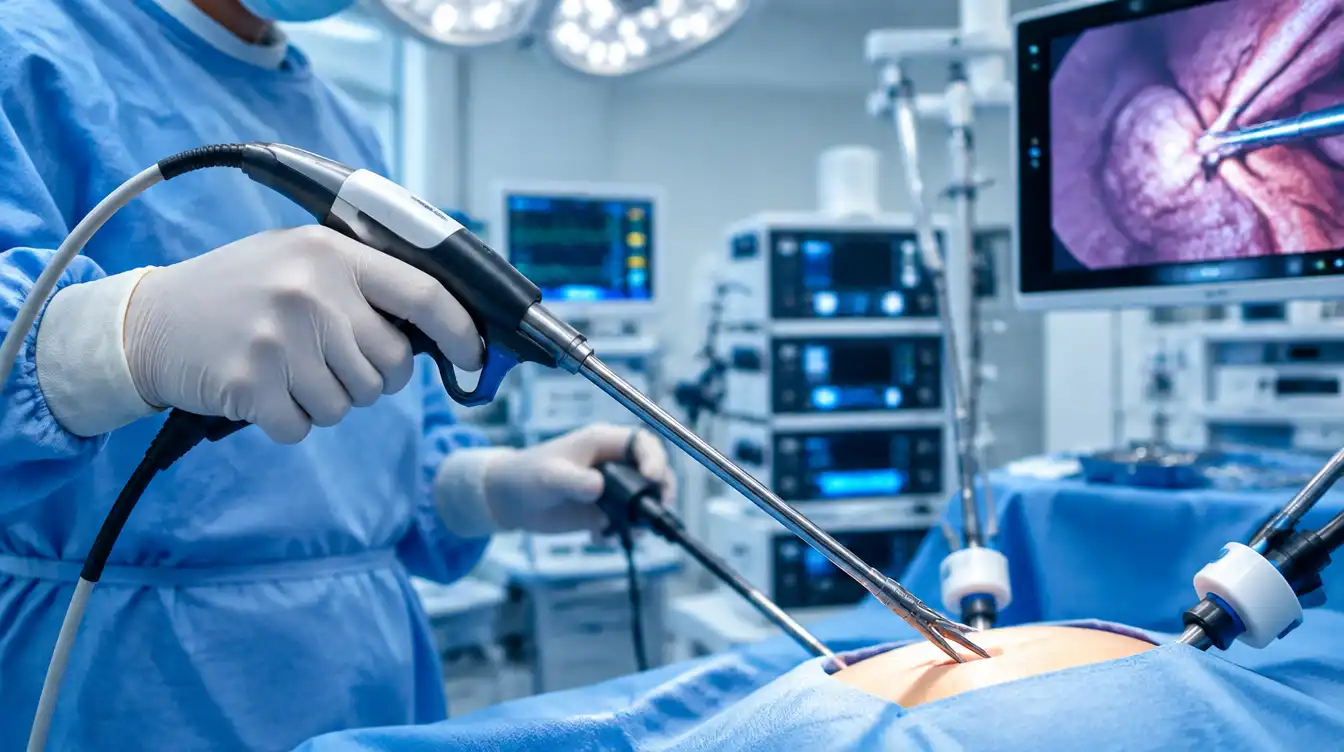
Modern surgery is more than just a job, it is a clean job! Precision and meticulous tissue handling are the name of the game these days, and surgeons require tools that match up. Introducing the Harmonic Scalpel: cuts and coagulates all in one smooth motion with ultrasonic energy, no extra instrument swaps required. In the operating room, where speed and precision are a key part of the surgery, the harmonic scalpel in surgery is a significant improvement, making it less messy, much quicker and, naturally safer for the patient.
Understanding Harmonic Scalpel Technology
Let's take a closer look at this thing. The Harmonic scalpel technology is based on a vibrating mechanism, which vibrates the blade about 55,000 times per second and in this vibration alone the tissue is cut and the vessels are sealed. No current flows through the patient at all, as it branches off from traditional electrosurgical devices requiring electrical energy to burn and seal.
The true difference between a scalpel and an ultrasonic scalpel is that the ultrasonic blade causes less heat to spread where it's not needed, less guesswork when working near fragile structures and more control in the surgeon's hands.This is a different way to cut and it's not just the new ultrasonic surgical instrument.
Trivia: “The blade vibrates so fast — nearly 55,000 times a second — that the human eye can't even register the motion.”
How Ultrasonic Energy Works During Surgery
The principle is simple: electrical energy is converted to high frequency mechanical vibration at the blade tip. It's the entire engine behind ultrasonic energy in surgery, as it can break up the tissue and heat proteins in vessel walls to close them in one pass. This harmonic scalpel working principle keeps things efficient without needing separate cutting and sealing steps, which is honestly the point.
How Harmonic Scalpel Enhances Surgical Precision
Surgical precision is no longer a luxury, it's the standard of excellence that both surgeons and patients demand, particularly in the area of fine margins around delicate anatomy that make the difference. This is where you can find it:
- With targeted energy application, surgeons are able to perform a dissection where it is required only, avoiding any unnecessary trauma to adjacent structures.
- Avoid accidental thermal injury near nerves, vessels and organs as a result of controlled tissue dissection.
- Handling delicate anatomy areas better means fewer complications in complex and minimally invasive procedures.
- Real-time control of cutting and coagulation allows surgeons to have confidence in the operation and not guesswork.
These harmonic scalpel benefits make it easier to create safer results with consistently precise tissue dissection.
Reduced Lateral Thermal Spread
The ultrasonic energy is contained more than traditional heat therapies and results in reduced thermal spread into non-target tissue.
That matters because unchecked heat can cause unintended tissue damage to nearby structures — nerves, vessels, organs you didn't mean to touch. One of the ultrasonic scalpel advantages that surgeons do not realize is to keep that spread tight.
How Harmonic Scalpel Improves Surgical Efficiency
Surgical efficiency is not just a desirable feature in the OR; it's a tangible impact on patient care outcomes, recovery time, and the seamless performance of an entire procedure. It's how it brings it to you:
- One tool for cutting and coagulation reduces the time spent switching between tools
- Less exchange of instruments also translates to less downtime during surgery and a more fluid flow for the entire team.
- Faster procedure time due to streamlined workflow, which is important for patient safety and for OR scheduling.
- Less handling, fewer steps, faster closure – efficiency adds up the longer, or more complex, the case is.
This kind of harmonic scalpel efficiency isn't flashy, but it's the difference surgeons feel by the end of a long case.
Key Surgical Applications of Harmonic Scalpel
The range of harmonic scalpel uses across specialties is honestly one of its biggest strengths — it's not built for just one type of procedure. It comes into play here:
- In the field of general surgery, where careful dissection and control of bleeding are essential, a broad range of common and complex procedures are carried out.
- In the case of laparoscopic surgery, the use of small and compact instruments and the lack of thermal spread due to limited space can be critical.
- Surgeries where control of the area is essential such as gynecological surgeries.
- Surgical procedures in the urological field for which precision around sensitive structures is directly related to the results,
The harmonic surgical applications illustrate the same reason why surgical teams of all specialties are always using the same dependable instrument.
Trivia: “Harmonic scalpels limit lateral thermal spread to just 1–2mm — far tighter than the several millimeters seen with conventional electrosurgery.”
Why Harmonic Scalpel Matters for Modern Surgical Facilities
It's not just clinical merit factors that influence the decision for procurement teams — budgets, training time, and OR throughput all play a role just as large. That's where Harmonic scalpel for hospitals earns its spot: one instrument supporting multiple specialties instead of separate tools for every department.
Whether or not surgical equipment stays in place beyond year one depends on things like compatibility, reliability in high caseloads, and a low learning curve for personnel. Advanced surgical instruments like this are viewed as an operational upgrade and part of a facility's toolkit that is used to reduce fewer complications and ensure consistent OR throughput — not just a spec sheet.
Why Surgeons Trust Sangam Surgicals
Selecting a surgical instrument partner is more than choosing an instrument that meets the right specifications on a page; it's about the people you have when you need them. Sangam Surgicals is unique in the following ways:
- Excessive variety of advanced surgical instruments, such as harmonic scalpel systems, produced and delivered to satisfy the genuine need of the OR.
- Quality that withstands examination and is designed to meet the real needs of hospitals and surgical centers.
- On time delivery and reliable supply – a late shipment should not be a reason to delay a procedure.
- Training, servicing, and answers when your team needs them that will stick around after the sale.
Therefore, with Sangam Surgicals, selecting the right surgical equipment partner is more than just a single transaction, it's about a partner that your OR can trust.
Trivia: “The first harmonic scalpel was introduced back in the 1990s, and it's still a go-to standard in laparoscopic surgery today.”
Conclusion
In the end, Harmonic Scalpel technology is all about one thing: more with less — precise cutting and coagulation in one motion, fewer instrument changes, a smoother OR workflow. These harmonic scalpel benefits aren't just theoretical, they show up case after case.
| If your hospital, surgical center, or distribution network is ready to upgrade, Explore Sangam Sugical's Harmonic Scalpel range and reach out to find the right fit for your team. |
FAQs Related to How Harmonic Scalpel Improves Precision and Efficiency in Surgery
A harmonic scalpel is used to cut tissue and seal blood vessels simultaneously using ultrasonic vibration, commonly in laparoscopic, general, gynecological, and urological surgeries.
It converts electrical energy into high-frequency mechanical vibration at the blade tip, which dissects tissue and denatures proteins in vessel walls to seal them shut.
It generally causes less thermal spread, produces less surgical smoke, and doesn't pass electrical current through the patient, making it a safer option near delicate structures.
There isn't one — "harmonic scalpel" and "ultrasonic scalpel" refer to the same instrument, both relying on ultrasonic vibration rather than electrical current.
Most harmonic scalpel systems reliably seal vessels up to 5-7mm in diameter, depending on the specific device and generator used.
Both options exist — reusable handpieces suit high-volume hospitals for lower long-term costs, while disposable versions are used for single-patient procedures requiring sterility.