
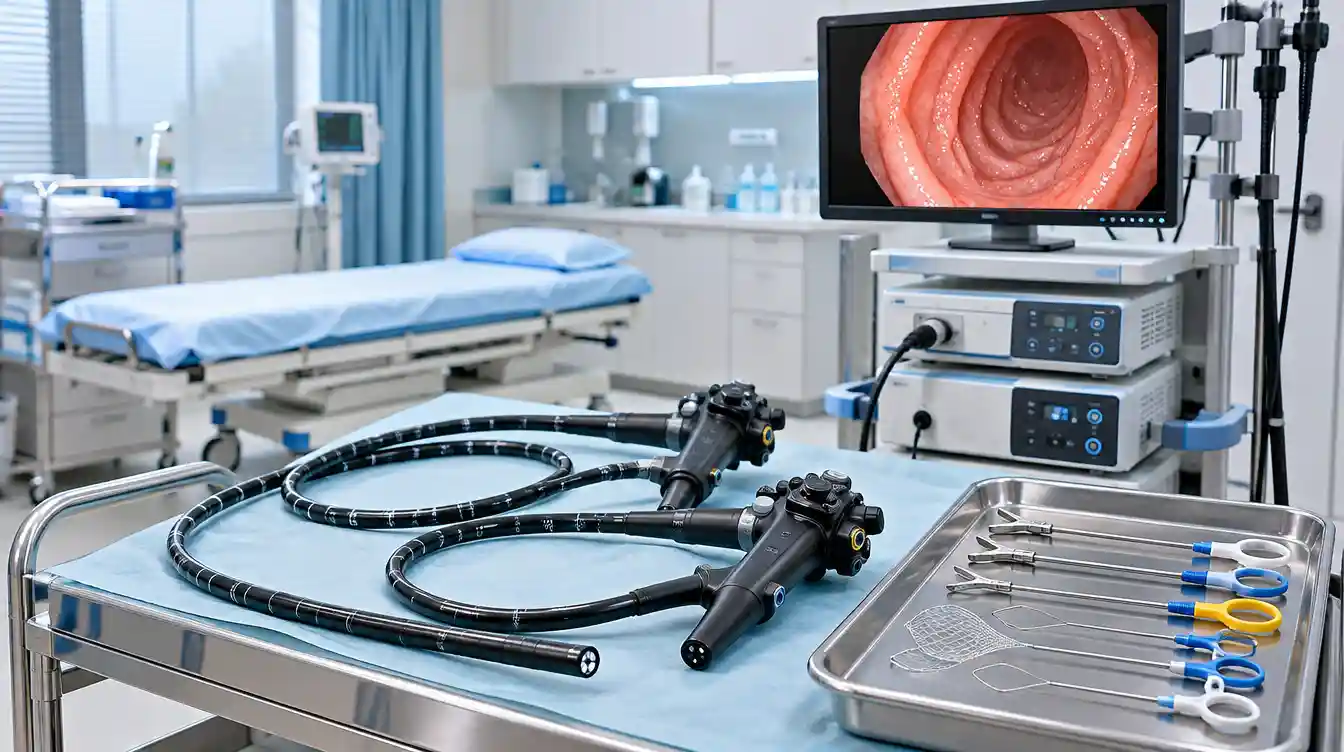
Every hospital GI department is powered by just a few handful of instruments that need to mesh. A scope without the right accessory, or a processor that isn't compatible with a scope will bring your list of procedures to a halt quickly. Gaps in your planning create delays, reorders and unused equipment.
This blog guides you through the essential gastrointestinal endoscopy instruments for your hospital department, their purpose, and how to plan for GI endoscopy instruments without the costly mismatches. Clear planning from day one prevents time, budget and delay risks.
What Are Gastrointestinal Endoscopy Instruments?
Gastrointestinal endoscopy instruments are the tools to see inside the digestive system, to take samples and to treat when necessary. This extends from the esophagus to the colon. Some are scope, some are accessories and some are imaging units that show what the scope sees.
In addition to the general endoscopy equipment used across all body systems, GI endoscopy equipment is designed specifically for the GI system. GI scopes are long, flexible, and paired with accessories that are small enough to gain access to the GI tract, which gives the endoscopist the ability to scope and treat in one visit.
Essential GI Endoscopy Instruments Used in Hospitals
Hospitals typically organize their GI endoscopy instruments set in three groups: scopes, their accessories inside, and the imaging system. These three make up a set of things called complete gastrointestinal endoscopy equipment for one department. Each of the two other sets rely on each other so the procedure room is incomplete if one is missing.
Gastroscopes and Colonoscopes
A gastroscope is a flexible tube inserted via the mouth down the esophagus to the stomach and duodenum. A colonoscope is longer, it is advanced down to the rectum and all the way into the large bowel. Both are a flexible endoscopy tool with a light, a camera and a working channel.
The working channel is important because all accessories go through it. As specifications differ across models and manufacturers, ensure that you verify these three points in the product documentation before purchasing:
| Specification | Gastroscope | Colonoscope | Why It Matters |
|---|---|---|---|
| Field of view | Typically 130° to 140° or wider | Typically 140° or wider | Decides how much mucosal wall is visible at once |
| Depth of field | Roughly 2 mm to 100 mm | Roughly 2 mm to 100 mm | Keeps both close and distant tissue in focus |
| Insertion tube outer diameter | About 9.2 mm to 9.5 mm | About 9.5 mm to 11.6 mm, up to 13 to 14 mm on some models | Affects patient comfort and maneuverability |
| Working-channel diameter | Typically about 2.8 mm | Typically 3.2 mm to 3.8 mm | Decides which accessories can pass through |
| Working length | About 1,030 mm to 1,100 mm | About 1,330 mm to 1,680 mm | Determines how far the scope can reach |
| Processor compatibility | Confirm supported series | Confirm supported series | Scope and processor must work as a pair |
| Reprocessing compatibility | Confirm with manufacturer | Confirm with manufacturer | Must fit your cleaning workflow |
Align them with those procedures your department performs most frequently, not with a generic spec sheet. Equipment handling and storage also influence the length of an instrument's life cycle, so adhere to the manufacturer's care instructions right from day one.
Biopsy Forceps, Polypectomy Snares and Retrieval Devices
Accessories threaded through the scope's channel are used to sample tissue, remove polyps, and retrieve objects. Endoscopic biopsy forceps obtain a small sample of tissue for analysis. A polypectomy snare encircles a polyp and removes it. Retrieval devices are used to retrieve foreign objects or excised tissue.
The Endoscopy accessory is going to have to fit the working channel, so always verify accessory diameter vs. channel size, and check length before you order. Some accessories are single-use, while others are reusable, so choose according to your reprocessing workflow and available storage space. Always check with the manufacturer; a good-value accessory is pretty useless if it won't go down your scope's working channel.
Endoscopy Video Processors, Light Sources and Monitors
The imaging chain converts what the scope detects to an image that the team can use. The endoscopy video processor takes the image from the scope. An endoscopy light source emits light and monitors carry the live image. The patient's tissue can be seen by the endoscopist, who then makes a decision.
Since these units need to be compatible with the scope model you are using, verify connector and system compatibility with the manufacturer. Find out what scope series each processor will accommodate. The quality of the image doesn't come from a single element, but a complete chain of endoscopy equipment. You can't make up for a weak light source with a great monitor.
How GI Endoscopy Instruments Support Hospital Procedures
Each procedure depends on a unique combination of instruments used in gastrointestinal endoscopy. A summary of the primary Gastrointestinal (GI) endoscopy procedures versus equipment types:
- Upper GI endoscopy: Gastroscope, light source, processor and monitor.
- Colonoscopy: Colonoscope with the same imaging chain
- Biopsy: Scope with biopsy forceps through the working channel
- Treatment steps: Snares, retrieval tools and other fittings that are compatible.
Observe how the imaging chain is duplicated in all procedures. That makes processor and light source shared resources, for their compatibility with the two types of scope should be considered early.
Key Factors When Selecting GI Endoscopy Equipment
Picking your GI endoscopy equipment is a matter of fit, not only feature-set. Using an ill-fitting system will take longer in the procedure room; rebuilding it later usually costs more than designing it correctly the first time. Consider these insights with your clinical and biomedical teams before you select any hospital endoscopy equipment:
- Image quality compatible with your techniques & monitors.
- Connecting to processors, light sources and accessories in scope.
- Working-channel dimensions that accept your planned accessories.
- Reprocessing requirements as per manufacturer instructions.
- Maintenance and service support, including spare availability.
- Manufacturers' Literature Instructions for use and manufacturers' publications
Require this information from each supplier in writing. Document comparison really highlights the gaps and adds concrete material to check against.
Service counts as much as specs. Endoscopy equipment is typically in use every day. Ensure you check what service options, spare stock and timings are available prior to confirming any order.
What Should Hospital Procurement Teams Check Before Ordering?
Confirm technical and commercial specifics of each line item before ordering. Save your department from the pain of mismatches and hidden costs when purchasing Endoscopy equipment for hospital use. Verify:
-
Technical specifications against Clinical needs.
- Compatibility between scopes, processors and accessories.
- Accessory requirements and recurring supply needs
- Supporting materials such as specifications, instructions for use.
-
Access and delivery timescales
- Total ownership cost, including service and consumables.
Ask endoscopy equipment suppliers in India that provide transparent specifications and respond to technical questions. Make sure the supplier also deals with questions once you have bought the equipment as questions often occur during installation and initial use. Obtain a written quotation for all items to be included in the order.
Why Choose Sangam Surgicals for GI Endoscopy Equipment?
Hospital buyers require clarity before taking on any equipment. Here is what you get from Sangam Surgicals if you are searching for endoscopy equipment suppliers in India, for your GI department:
- One of the special categories of endoscopy equipment that it has in its broader range of surgical goods.
- Click to view equipment listings available to browse aligned to your department's requirements.
- Feel free to ask about specifications, what's available now and your needs.
- Good place to begin your research for endoscopy instrument manufacturers in India.
- Open inquiries for the procurement needs of the hospital, directly to Sangam Surgicals.
Let us know your process list and compatibility needs when you ask. Be clear about your requirements so the team can guide you to the correct listings more quickly.
Conclusion
Right gastrointestinal endoscopy instruments help every day go a little more smoothly. We consider scopes, accessories and imaging systems to find the best fit, and we recommend GI endoscopy equipment supplies based on actual procedure volumes. Review documentation, reprocessing requirements and service support when selecting GI equipment, and a connected, well-documented system can help you keep your list of procedures moving.
| Want to buy GI endoscopy instruments? Just put forward your needs to Sangam Surgicals and seek details regarding specifications and available at the earliest. |
FAQs Related to GI Endoscopy Instruments: Essential Equipment for Hospital Departments
You need the following basic gastrointestinal endoscopy instruments including gastroscopes, colonoscopes, biopsy forceps, polypectomy snares, retrieval devices, video processors, light sources and monitors, and more. Your specific requirements will relate to the types of procedures carried out.
You need the following basic gastrointestinal endoscopy instruments including gastroscopes, colonoscopes, biopsy forceps, polypectomy snares, retrieval devices, video processors, light sources and monitors, and more. Your specific requirements will relate to the types of procedures carried out.
For hospital endoscopy equipment, check equipment specifications, accessory requirements, suppliers' documentation, availability, owning cost – service and consumables.
A gastroscope looks at the upper part of your digestive system using your mouth. The colonoscope is longer and looks at the large bowel from the back passage. Both of them are flexible and have a light, a camera and work channel.
It processes the data from the scope and creates the image you see on the screen. You need to ensure that it is compatible with your particular scope - check this with the manufacturer.
Scopes and reusable accessories should be cleaned and disinfected between patients. Ask for the manufacturer's reprocessing instructions ahead of purchasing to make sure the equipment can be integrated into your department's workflow.