
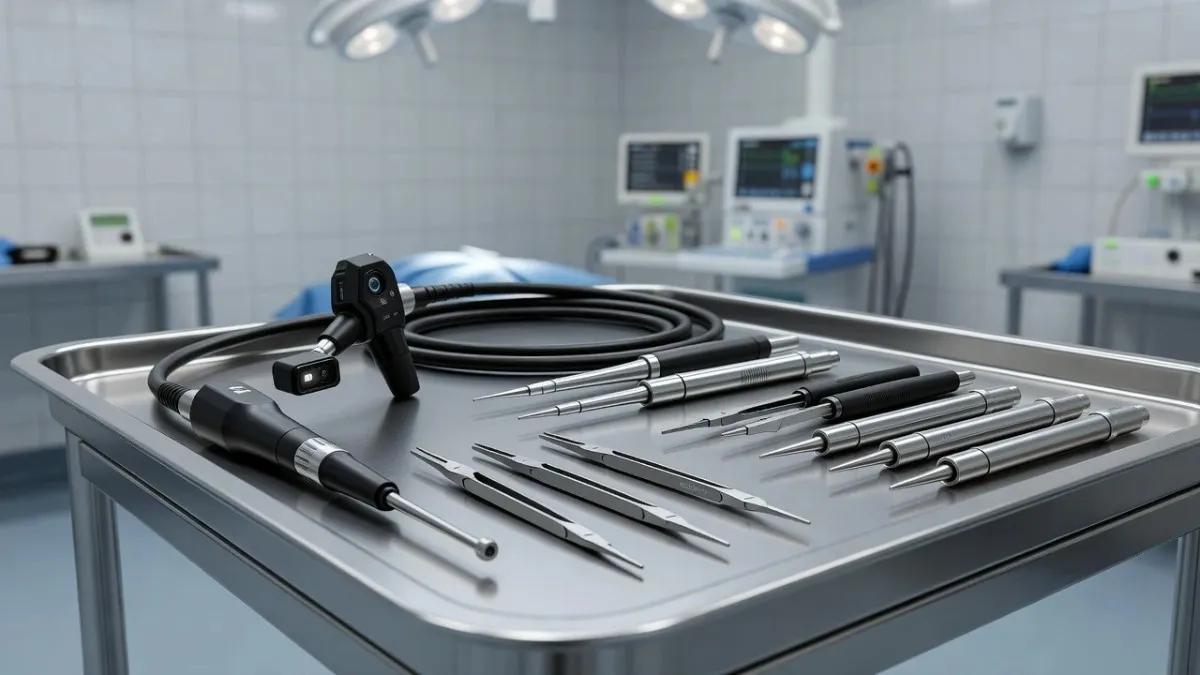
Did you know 7 million endoscopies are performed worldwide every year? Instruments must be reliable to achieve successful procedures and therefore be of a good quality.
Knowledge of endoscopy instruments is a must for hospitals, clinics, B2B customers, and other healthcare and medical device companies and professionals. Selecting the correct endoscopy instrument helps in increased efficiency, improved patient safety, and better diagnostic capabilities. If you are looking into researching an endoscopy instrument set, comparing endoscopy instrument price options, or planning to buy endoscopy instruments, the right information is important. In this guide, we look at the various types of endoscopy instruments and their working, advantages and disadvantages of each, and tips for buying endoscopy instruments.
What are Endoscopy Instruments?
An Endoscopy instrument is a medical device used to look into, and sometimes treat, various internal organs and spaces of the body without open surgery. Endoscopy instruments are used for endoscopic procedures - a flexible or rigid tube with a light source which is inserted into the body:
Imagine endoscopic instruments as eyes and hands of a doctor inside the body. Similar to a mechanic who uses special tools to look inside an engine without removing the head, doctors use endoscopic devices to look into the human body and perform procedures. They are vital to minimally invasive medicine.
Here are the Types of Endoscopy Instruments
- Endoscopes
- Biopsy Forceps
- Snares
- Retrieval Devices
- Dilators
- Injection Needles
Types of Endoscopy Instruments
Endoscopy Instruments are classified according to their use and type.
| Instrument Type | Primary Function | Common Applications |
|---|---|---|
| Endoscopes | Visualization | Diagnosis and examination |
| Biopsy Forceps | Tissue collection | Biopsy procedures |
| Snares | Tissue removal | Polyp removal |
| Retrieval Devices | Foreign body extraction | Gastrointestinal procedures |
| Dilators | Widening narrowed passages | Esophageal treatments |
| Injection Needles | Medication delivery | Therapeutic procedures |
Endoscopes
The endoscopes are the most common instruments used in endoscopic procedures. They have cameras, light sources and accessory channels inside them. The endoscope could be flexible or rigid, according to the procedure needs.
Biopsy Forceps
Biopsy forceps – These are used to take tissue biopsies of internal organs. These tissues are then sent to laboratories for analysis to diagnose disease for example cancer or infection.
Snares
Snares are wire-loop devices that are typically used to excise polyps or abnormal tissue growths. They assist doctors in carrying out tissue removal procedures on a less invasive basis.
Retrieval Devices
Used to extract foreign objects, stones and other ingested materials. These devices increase safety for the patients and reduce the need for surgery.
Dilators
Dilators are used to extend the walls of constricted passageways within the gut as well as within other parts of the body. They are used in the treatment of strictures and obstructions.
Injection Needles
With BAK also, the medications, dyes, or other therapeutic substances can be injected into the tissues through the needle of the endoscope.
How Endoscopy Instruments Work / Key Characteristics
The endoscopy instruments operate in conjunction with the complete system of diagnosis and treatment.
- Insertion and Access: The endoscope is introduced into the body either through a natural opening or by a small surgical cut. The internal camera lets the endoscope be immediately observed.
- Illumination: Light intensity is such that structures are illuminated during examination. Enables clear imaging.
- Image Transmission: The camera provides images and live video. Images are sent to monitors for use by the physician.
- Channels for Instrument Use: Accessory instruments can be inserted through channels in the endoscope. Suction Devices like forceps and snares may be used within the scope.
- Treatment and Intervention: So the doctor can perform biopsies, remove tissue, arrest hemorrhage or administer drugs. Many of these are carried out without conventional surgical procedures.
Key characteristics include the following:
- High-definition imaging
- Flexible maneuverability
- Sterilisation compatibility
- Precision control
- Minimal invasiveness
Quick-Reference Endoscopy Buying Guide
When acquiring endoscopic devices for a hospital or clinic, purchases shouldn‘t solely consider up-front cost but also structural compatibility, clinical efficacy and lifecycle costs. Use this simple four step grid to make the most of your investment:
1. Optical & Mechanical Specifications
Imaging features of the system. The imaging quality determines the accuracy of the diagnosis. Use a CMOS camera sensor rather than old CCD chips; CMOS provides better picture resolution, lower power consumption, and less heat at the tip of the endoscope. For efficient therapy, choose a scope with fine optics filtration (Narrow Band Imaging or equivalent) and a distal tip angulation of no less than 180° 210° for flexible endoscopy.
2. Accessory & Tower Interoperability
Perform cross-contamination checks with other brands to Prevent Proprietary Lock-In. The Endoscopy Set needs to perfectly match with your current video processors and light sources. In addition to this, the Accessory Channel Matching is also strictly needed: the scope working channel‘s internal diameter (ID) should be 0.2 mm to 0.3 mm larger than that of your biopsy forceps, snares and injection needles OD to prevent the internal channel‘s friction and expensive tearing.
3. Total Cost of Ownership (TCO)
The sticker price on an endoscope accounts for only approximately 35% of the endoscope's lifetime costs. Consider the factors below operational issues before signing:
- Reprocessing Compatibility: As mentioned earlier,must be compatible with your CSSD simple automated endoscope reprocessors(AERs) or autoclaves.
- Turnaround Logistics: When a scope needs to be sterilized in long periods of low-temperature gas, you need to purchase extra backup sets to keep the daily patient volume steady.
- SLAs: Obtain an SLA to ensure OEM parts and a loaner scope (24 to 48 hours) to remove downtime.
4. Reusable vs. Single-Use (Disposable)
Match your acquisition model to your facility‘s volume:
- Reusable Systems: Suitable for large-volume gastroenterology or urology suites where significant expensive capital investment can be amortized over hundreds or thousands of procedures.
- Single-Use scopes: Ideal for emergency rooms, ICUs, and small-volume satellite clinics. This strategy has no reprocessing labor, no risk of cross-contamination, and low initial capital.
Fun Fact: Endoscopes can be so small that they can be thinner than a matchstick, so that their pen drawing would be able to get into very tight spots inside the body.
Advantages of Endoscopy Instruments
Here is the list of advantages of endoscopy instruments for your better understanding:
Minimally Invasive Procedures
Endoscope instruments allow for smaller surgical incisions. They bring less pain and faster recovery.
Improved Diagnostic Accuracy
A high-quality image allows the doctor to better detect abnormalities. The sooner these abnormalities are found the more effective the treatment may be.
Reduced Hospital Stays
For many of the endoscopic procedures, outpatient procedures are carried out. This decreases healthcare costs and offers increased convenience to the patient.
Enhanced Patient Safety
Smaller incisions and more precise intervention lead to less surgery less complications.
Versatile Clinical Applications
Endoscopes are utilised in various specialties, such as gastroenterology, gynecology, pulmonology, and urology.
Disadvantages of Endoscopy Instruments
Here are the various disadvantages of endoscopy instruments for better awareness:
High Initial Investment
The cost of the endoscopy instruments may also be quite high, particularly for the higher-end imaging systems and specific accessories.
Maintenance Requirements
They are then to be cleaned, sterilised and checked on a regular basis for safe application and for long-term dependability.
Training Needs
Training is essential for healthcare professionals.
Equipment Wear and Tear
The unit could become worn with repeated use - repair/ replacement cost.
Did you know? This is a capsule endoscope. It is a small camera that the patient swallows and it takes over 50,000 pictures as it journeys through the bowel.
Key Benefits & Real-World Applications
Diagnostic instruments are certainly used far more widely during endoscopy than merely to diagnose what is wrong. They are used by hospitals on a regular basis in order to find out about gastric problems, ulcers, tumours or inflammatory disease.
E.g. a gastroenterologist utilizing Endoscopy Instruments Set to react to find and excise pre-cancerous polyps during a colonoscopy will prevent the occurrence of colorectal carcinoma.
Most pulmonologists and urologists use scopes to look inside people‘s lungs/airways and urinary tract, respectively. Frequently, these outpatient surgical procedures are an option, and patients can return to their homes the same day.
Choosing endoscopy instruments, healthcare facilities are generally interested in the quality of the image, durability, ease of sterilization and after-sales support. Dealing with a trusted Endoscopy Equipment Supplier provides for standard fulfillment and longevity.
About Us
Sangam Surgicals was founded in 2014 by Mr. Rajkumar Singh with one clear purpose — put better instruments in the hands of surgeons. The company supplies and exports surgical instruments to hospitals and clinics across India and globally. The range covers laparoscopy, gynaecology, urology, arthroscopy, endoscopy, harmonic scalpels, and surgical staplers — all made from premium-grade stainless steel, built to international quality standards. With ISO-compliant processes and a team of 25+, Sangam Surgicals has spent over a decade doing one thing well: delivering instruments that perform when it matters most. Precision isn't a feature here. It's the baseline.
Conclusion
Endoscopy instruments are vital equipment in contemporary medicine, allowing minimally invasive diagnosis and therapy in many branches of medicine. A basic understanding of the various types of instruments, their respective roles and pros and cons can allow a clinician or administrator to make the best purchasing decisions, whether considering an endoscopy instrument set, comparing endoscopy instrument price choices or simply wondering where to buy endoscopy instruments from top Endoscopy Equipment Suppliers.
| Explore premium Endoscopy Instruments and request your free quote today. |
FAQs Related to Endoscopy Instruments: Types and Buying Guide
Endoscopy instruments are specialized devices used to diagnose and treat conditions within the body.
Endoscopy instrument set include endoscopes, forceps, snares, needles and retrieval devices.
Endoscopy instruments prices are different based on the type, brand, technology etc. of the product.
You can purchase them from authorized medical equipment suppliers and Endoscopy Equipment Suppliers.
They offer increased precision of diagnostics, increased patient safety, and increased overall efficiency of procedures.